Followers

Showing posts with label unit 8. Show all posts

Tuesday

Unit 8 Online Practice Exercises & Review

UNIT 8
1. LINKING IDEAS

Transitions and linking words perform an important function in writing. They signal to the
reader the direction the writer is taking. They do this by connecting or linking ideas within a
paragraph and providing a bridge between paragraphs. Remember to proofread the writing
assignment to make sure transitions are used effectively. For more information and practice see this link. http://www.ssdd.uce.ac.uk/learner/writingguides/1.33.htm


TO SHOW ADDITION:
additionally
again
also
and,
another
besides
finally
first, second, etc.
further
furthermore
incidentally
lastly
likewise
moreover
next
nor
too
along with
as well
equally important
for example
for instance
in addition
what’s more
TO SHOW TIME:
about
after
afterward
at
before
currently
during
eventually
finally
first, etc.
following
formerly
immediately
later
meanwhile
next
next week
previously
soon
subsequently
then
thereafter
till
today, etc.
until
when
after a few hours
as soon as
in the future
soon after
TO SHOW LOCATION:
above
across
adjacent
against
along
among
along
among
around
behind
below
beneath
beside
between
beyond
by
down
inside
into
here
near
nearby
off
onto
outside
over
there
throughout
under
away from
at the side
in the back
in back of
in the background,
in the distance
in the front
in the foreground
on top of
to the right
TO SHOW COMPARISON:
also
as
like
likewise
meanwhile
similarly
simultaneously
after all
at the same time
by and large
in comparison
in the same way
in the same manner
in the same way
TO SHOW CONTRAST:
although
but
conversely
however
nevertheless
nonetheless
notwithstanding
otherwise
still
true
yet
although this is
and yet
even though
for all that
in contrast
on the contrary
on the other hand
while this is true

TO EMPHASIZE A POINT:
again
obviously
truly
undoubtedly
as a matter of
fact
for this reason
in fact
to emphasize
to repeat
TO CLARIFY:
for instance                      
in other words
put another way
that is
TO GIVE EXAMPLES:
namely
specifically
as an illustration
for example
for instance

to demonstrate
to illustrate

TO INTRODUCE AS A RESULT:
accordingly
consequently
so
therefore
thus
as a result
due to this
TO INTRODUCE CONCLUSIONS:
accordingly
consequently
finally
hence
so
therefore
thus
as a result
in brief
in conclusion
in short
in summary
on the whole
to conclude
TO SUMMARIZE:
finally
by and large
in brief
in conclusion
in summary
on the whole
summing up
to conclude


Friday

The 84th Academy Awards

The official trailer of the 84th Academy Awards®.

Visit the official site of the 84th Academy Awards, or the page of the Academy for up to date Oscars news

Why Do the Oscars Hate Laugh-Out-Loud Comedies?


In an article for The Atlantic, Kenneth Fallon, assistant editor at TheWeek.com and a former producer of The Atlantic's Entertainment channel, argues that funny, well-reviewed films with broad appeal almost never get nominated for Best Picture. Read Fallon's article, and look through the slides of popular funny movies that never got an Oscar nomination, at The Atlantic.


'Hugo:' A Dazzling 3-D Display Of Movie Magic

Read this movie review of Oscar nomminated film, Hugo from npr, then watch the clip from the film below.

by 


In Hugo, Martin Scorsese has hired himself a bunch of A-plus-list artists and techies, and together they've crafted a deluxe, gargantuan train-set of a movie in which the director and his 3-D camera can whisk and whizz and zig and zag and show off all his expensive toys — and wax lyrical on the magic of movies.
The source is Brian Selznick's illustrated novel The Invention of Hugo Cabret, which takes place in 1930 and centers on an orphaned 12-year-old, played in the film by Asa Butterfield, who lives in a flat in the bowels of the Paris station.
Hugo's drunken uncle, until he went missing, had the job of setting the station's clocks, so now the boy, to cover for the disappearance and stay out of the orphanage, does the job in secret, stealing through tunnels, up rickety ladders and over catwalks, careful to avoid Sasha Baron Cohen's stationmaster with his relish for orphan-catching.
For a while, Hugo's only company is a semi-complete automaton, a kind of primitive mechanical man that his late machinist dad (Jude Law, seen in flashback) discovered in a museum storage area. Hugo thinks the automaton holds the key to his future; alas, the key it doesn't hold is the one that would wind it up and set it in motion.
Scorsese, working from a shapely script by John Logan, is hell-bent on bedazzling us. He and production designer Dante Ferretti pack the screen with clocks and gears and cogs and other round objects that also evoke the film canisters that show up later, when pioneer fantasy filmmaker Georges Melies turns up as a character.
The 3-D cinematography by Robert Richardson is calculated to tickle you, most obviously in shots in which the stationmaster's Doberman pinscher sticks its long snout into your face, but more subtly when the train station is layered with booths and passengers at all kinds of levels, and when overhead shots create odd spatial tensions in the frame, obstacles around which bodies invariably hurtle.
Scorsese has studied the best 3-D films, not just Cameron's Avatar but Hitchcock's Dial M For Murder, and, as far as I'm concerned, redeemed this increasingly tiresome form. Cameron has agreed, calling Hugo at a recent screening a "masterpiece."
I liked the film a lot, but am not so ready to use the "m" word. When Melies appears, the movie becomes a plea for Scorsese's film-preservation cause — which I'm 100 percent behind, but which introduces an element of self-consciousness that pulls the narrative off the rails.
Abandoned by an alcoholic uncle after the death of his father, Hugo services the train station tower clock by day and sleeps in it by night.
Jaap Buitendijk/Paramount Pictures
Abandoned by an alcoholic uncle after the death of his father, Hugo services the train station tower clock by day and sleeps in it by night.
For all the wizardry on display, Hugo often feels like a film about magic instead of, well, a magical film — something Steven Spielberg has made with his 3-D movie Tintin, opening in December. Wonderful insights into Hugo's mind about the overlap between man and machine get a bit upstaged when he expresses them to his new 13-year-old friend, played by Chloe Grace Moretz.
Those two kids, Butterfield and Moretz, have a wonderful transparency, and the cast is a treat. Baron Cohen finds all kinds of bizarre notes with which to express his ardor for a flower-stand owner (Emily Mortimer), among them a rictus grin that suggests Peter Sellers. That hoary genre veteran Christopher Lee — now Sir Christopher — lends majesty to the role of a librarian, and Michael Stuhlbarg is winningly geeky as an early film scholar.
Ben Kingsley as Moritz's godfather, who runs a toy stand, is mysteriously cold and brittle, even cruel — but when all is revealed, we warm up to him.
At its best, in scenes with the automaton and its Mona Lisa smile, and in an explosive runaway-train nightmare, Scorsese is as deft as Spielberg. When he shows us a famous clock-hanging sequence in Harold Lloyd's Safety Last and tries to replicate it, he's trying too hard. The clips from such Melies wonders as A Trip to the Moon show a delirious unreality that's a world away from Hugo's literal-minded wonders.

Watch Clips

But I carp. You must heed the subliminal advertising in the title. YOU GO.

Biopic Pictures & The Oscars


To say that the biopic picture and performances have dominated the Academy awards over the years would be a bit of an understatement.
Biopic PicturesThe Academy and cinema audiences seem fascinated with these real life stories and characters brought to life - and next years awards season looks set to be no different.
My Week With Marilyn and Moneyball, both of which are released this week, are already amongst the early Oscar favourites.
Michelle Williams looks set to bag a Best Actress nod while Brad Pitt will most likely receive a nomination for his central performance as Billy Beane in Moneyball.
Also keep an eye out for Meryl Streep as Margaret Thatcher in The Iron Land and Leonardo DiCaprio as J Edgar Hoover in J Edgar who you would also expect to be in the mix when the nominations start rolling in.....

 This article was written in November, 2011. How accurate were the predictions on Oscar nominations?

- Read the rest of the article and take a look at some clips from Moneyball.

Thursday

John F. Nash Autobiography from NobelPrize.org


Born: 13 June 1928, Bluefield, WV, USA
Affiliation at the time of the award:Princeton University, Princeton, NJ, USA
Prize motivation: "for their pioneering analysis of equilibria in the theory of non-cooperative games"
Field: Game theory
Contribution: Introduced the distinction between cooperative games, in which binding agreements can be made, and non-cooperative games, where binding agreements are not feasible. Developed an equilibrium concept for non-cooperative games that now is called Nash equilibrium
John F. Nash Jr.


My beginning as a legally recognized individual occurred on June 13, 1928 in Bluefield, West Virginia, in the Bluefield Sanitarium, a hospital that no longer exists. Of course I can't consciously remember anything from the first two or three years of my life after birth. (And, also, one suspects, psychologically, that the earliest memories have become "memories of memories" and are comparable to traditional folk tales passed on by tellers and listeners from generation to generation.) But facts are available when direct memory fails for many circumstances. My father, for whom I was named, was an electrical engineer and had come to Bluefield to work for the electrical utility company there which was and is the Appalachian Electric Power Company. He was a veteran of WW1 and had served in France as a lieutenant in the supply services and consequently had not been in actual front lines combat in the war. He was originally from Texas and had obtained his B.S. degree in electrical engineering from Texas Agricultural and Mechanical (Texas A. and M.). My mother, originally Margaret Virginia Martin, but called Virginia, was herself also born in Bluefield. She had studied at West Virginia University and was a school teacher before her marriage, teaching English and sometimes Latin. But my mother's later life was considerably affected by a partial loss of hearing resulting from a scarlet fever infection that came at the time when she was a student at WVU.

Read more at nobelprize.org


Homophones, Homonyms, and Homographs

They perplex us, confuse us, and make our heads spin. If you thought learning how to correctly spell words that sound alike was difficult, wait till you try to learn the terms for describing those words.

Read about homophones, homonyms and homographs at writingforward.com.

Then browse through the 200 Homonyms, Homophones, and Homographs at about.com.
(Scroll down to find the lists of words C-E, F-L, M-R and S-W

Contrasting Ideas


Try these quizes to see how well you are able to manage contrasting ideas

:

John Forbes Nash Talks About His Mental Illness


Although he took prescribed medication, Nash wrote later that he only took it under pressure. After 1970, he was never committed to the hospital again and refused any medication. According to Nash, the film A Beautiful Mind inaccurately showed him taking new atypical antipsychotics during this period. He attributed the depiction to the screenwriter (whose mother, he notes, was a psychiatrist), who was worried about encouraging people with the disorder to stop taking their medication. The film has Nash saying around the time of his Nobel prize in 1994: "I take the newer medications", when in fact Nash did not take any medication from 1970 onwards. Ron Howard later stated that they added the line of dialogue because it was felt as though the film was encouraging the notion that all schizophrenics can overcome their illness without medication.

Wednesday

The Pulitzer Prizes

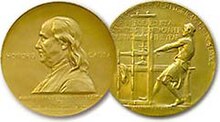
The Pulitzer Prize is a U.S. award for achievements in newspaper and online journalism, literature and musical composition. It was established by American (Hungarian-born) publisher Joseph Pulitzer in the year 1917 and is administered by Columbia University in New York City. Prizes are awarded yearly in twenty-one categories. In twenty of these, each winner receives a certificate and a US$10,000 cash award. The winner in the public service category of the journalism competition is awarded a gold medal, which always goes to a newspaper, although an individual may be named in the citation.

Joseph Pulitzer
"In the latter years of the 19th century, Joseph Pulitzer stood out as the very embodiment of American journalism. Hungarian-born, an intense indomitable figure, Pulitzer was the most skillful of newspaper publishers, a passionate crusader against dishonest government, a fierce, hawk-like competitor who did not shrink from sensationalism in circulation struggles, and a visionary who richly endowed his profession.

His innovative New York World and St. Louis Post-Dispatch reshaped newspaper journalism. Pulitzer was the first to call for the training of journalists at the university level in a school of journalism. And certainly, the lasting influence of the Pulitzer Prizes on journalism, literature, music, and drama is to be attributed to his visionary acumen."

Read more about the history of the Pulitzer Prizes, the Biography of Joseph Pulitzer, and more on the official Pulitzer Prize page.

The Profile in Courage Awaard

The Profile in Courage Award was created in 1989 by members of President John F. Kennedy's family to honor President Kennedy and to recognize and celebrate the quality of political courage that he admired most. The award is named for President Kennedy’s 1957 Pulitzer prize-winning book, Profiles in Courage, which recounts the stories of eight U.S. Senators who risked their careers by taking principled stands for unpopular positions.
The Profile in Courage Award seeks to make Americans aware of the conscientious and courageous acts of their public servants, and to encourage elected officials to choose principles over partisanship – to do what is right, rather than what is expedient. The award is presented annually to a public official or officials at the federal, state or local level whose actions best demonstrate the qualities of politically courageous leadership in the spirit of Profiles in Courage.
2005 PICA lanternThe Profile in Courage Award is administered by the John F. Kennedy Library Foundation. A distinguished bipartisan committee named by the Foundation reviews all nominations, and selects the recipient or recipients of the award.
The award is presented each May at a ceremony at the John F. Kennedy Presidential Library and Museum in connection with the observance of President Kennedy’s May 29 birthday. The award is represented by a sterling silver lantern, modeled after the lantern on the USS Constitution, the oldest commissioned ship in the U.S. Navy. The lantern was designed by Edwin Schlossberg and crafted by Tiffany & Co.

Read more about the prize, eligibility requirements, the nomination process and more on jfklibrary.org

10 Greatest Paintings


Portrait Of Adele Bloch Bauer 01There are many different opinions about art and paintings, and probably no two people would  choose exactly the same 10 paintings as the world's greatest. One constant, however, seems to be the inclusion of the  Mona Lisa in the top 10, usually in the #1 spot.

At the Masters Mind there is an interesting list of 10 greatest paintings of fascinating models. Take a look at a glimpse of the personal lives of the people that have posed as subjects or models in 10 well known paintings.

Ig Nobel Prizes

The Ig Nobel Prizes are an American parody of the Nobel Prizes and are given each year in early October for ten unusual or trivial achievements in scientific research. The stated aim of the prizes is to "first make people laugh, and then make them think". The awards are sometimes veiled criticism (or gentle satire). Organized by the scientific humor magazine Annals of Improbable Research (AIR), they are presented by a group that includes Nobel Laureates at a ceremony at Harvard University's Sanders Theater, and they are followed by a set of public lectures by the winners at MIT.
All prizes are awarded for real achievements (except for three in 1991 and one in 1994 due to an erroneous press release).
The 2011 recipients were:

  • Biology: Daryll Gwynne and David Rentz for discovering that certain kinds of beetle mate with certain kinds of Australian beer bottle.
  • Chemistry: Makoto Imai, Naoki Urushihata, Hideki Tanemura, Yukinobu Tajima, Hideaki Goto, Koichiro Mizoguchi and Junichi Murakami for determining the ideal density of airborne wasabi(pungent horseradish) to awaken sleeping people in case of a fire or other emergency, and for applying this knowledge to invent the wasabi alarm.
  • Literature: John Perry of Stanford University for his Theory of Structured Procrastination, which states: "To be a high achiever, always work on something important, using it as a way to avoid doing something that's even more important."
  • Mathematics: Dorothy Martin of the USA (who predicted the world would end in 1954), Pat Robertson of the USA (who predicted the world would end in 1982), Elizabeth Clare Prophet of the USA (who predicted the world would end in 1990), Lee Jang Rim of Korea (who predicted the world would end in 1992), Credonia Mwerinde of Uganda (who predicted the world would end in 1999), and Harold Camping of the USA (who originally predicted the world would end on September 6, 1994, and later predicted that the world will end on May 21, 2011, which preceded his final prediction on October 21, 2011), for teaching the world to be careful when making mathematical assumptions and calculations.
  • Medicine: Mirjam Tuk, Debra Trampe and Luk Warlop, and jointly to Matthew Lewis, Peter Snyder, Robert Feldman, Robert Pietrzak, David Darby and Paul Marufffor demonstrating that people make better decisions about some kinds of things – but worse decisions about other kinds of things – when they have a strong urge to urinate.
  • Peace: Arturas Zuokas, the mayor of Vilnius, Lithuania, for demonstrating that the problem of illegally parked luxury cars can be solved by running over them with a tank.
  • Psychology: Karl Halvor Teigen of the University of Oslo, Norway, for trying to understand why, in everyday life, people sigh.
  • Physics: Philippe Perrin, Cyril Perrot, Dominique Deviterne, Bruno Ragaru and Herman Kingma for trying to determine why discus throwers become dizzy, and why hammer throwers don't, in their paper "Dizziness in discus throwers is related to motion sickness generated while spinning".
  • Physiology: Anna Wilkinson, Natalie Sebanz, Isabella Mandl and Ludwig Huber for their study "No evidence of contagious yawning in the red-footed tortoise Geochelone carbonaria".
  • Public safety: John Senders of the University of Toronto, Canada, for conducting a series of safety experiments in which a person drives an automobile on a major highway while a visor repeatedly flaps down over his face, blinding him.